Written by Adrianna Hines
A marker of the queer experience is the familial bonds formed outside of biological or legal connections. Anthropologist David Schneider’s famous study on American kinship proposes that family relations in the U.S. are based on symbolics that lie in the division between the order of nature (or shared biogenetics) and the order of law (Jackson & Kattari & Piellusch & Watson, 2020). However, queer relationship dynamics are abnormal in that they operate outside of these domains. In social science discourse, the term “chosen family” can be traced to Kath Weston’s study, “Families We Choose: Lesbians, Gays, Kinship” in which she describes the role of close friends in the lives of sexual minorities and how these minorites experiences otherness. Weston intentionally treats family “not so much as an institution, but as a contested concept, implicated in relations of power that permeate societies ((Jackson & Kattari & Piellusch & Watson, 2020 ).” Her research focuses on the HIV/AIDS crisis in 1980s San Francisco and how when the bio-families of LGBTQ patients refused to handle their end of life care, in many cases their close, personal friends stepped in to help. These “counter-hegemonic cultures of care” allow support in the form of things like mutual aid to flow freely, outside of the rigid legal or social regulations (Jackson & Kattari & Piellusch & Watson, 2020).
In the study titled “Navigating ‘Chosen Family’ in the Context of Health, Illness, and the Mutual Provision of Care amongst Queer and Transgender Young Adults,” researchers examined how queer youth in the U.S. experience great obstacles when receiving care in the medical field whether in the form of ignorant practitioners or the lack of legally binding guarantees to basic health care. In 2015 ⅓ of transgender or nonbinary patients reported negative interactions with their healthcare provider based on their queer identities (Jackson & Kattari & Piellusch & Watson, 2020). When affirming care is inaccessible, chosen family members are that much more important in providing support. In the study, researchers employed loosely structured interviews as their methodology and required participants to fill out a demographic screening sheet in order to gain information on the participant’s gender identity, sexual orientation, race, disabilities/illnesses, etc…
The findings illustrate the overarching theme that queer youth endure a great deal of medical trauma and utilize their close personal friendships as a substitute in the place of strained family relationships. For example, one participant, given the pseudonym “Clive” [identifying as a transmasculine, agender person], described their journey finding someone to accompany them to their upcoming top surgery. Clive details asking one of their transmasculine friends [who already went through the top surgery process and had experience vetting doctors] to accompany them. In Clive’s words, their advocate “ did the research, [and has] been through those kind of shitty experiences before me where it’s like—yes, they will do top surgery but they won’t respect your pronouns the whole time and they might fudge it up a little bit because they’re used to doing breast reductions [in contrast to top surgeries as part of medical transition]….I have a hard time advocating for myself in [medical settings], so I think having someone there who would consistently correct pronouns, or—you know, someone who has no skin in the game…Because, for me, if I speak up they’re gonna not want to help me or whatever… (Jackson & Kattari & Piellusch & Watson, 2020)”
The researchers further examined how queer people cultivate their own systems of care by asking participants about who they keep as their emergency contact when they cannot rely on their strained relationships with family. In one instance, a participant named “Grey” [a transmasculine person who identifies as pansexual and asexual] recounted a time in which they had experienced a medical emergency and realized that their mother was still their emergency contact stating, “That was a time in my life that I wasn’t talking to my mother and I realized it was kind of absurd to still be putting her as my emergency contact when I wasn’t actually talking with her, cause I was like ‘golly that would be an uncomfortable phone conversation or an uncomfortable interaction,’ if something did happen to me and all of a sudden my mother shows up (Jackson & Kattari & Piellusch & Watson, 2020).”
Photo: San Francisco based HIV and Cancer agency, The Shanti Project holding a community care support group in 1985 for victims of the Aids epidemic
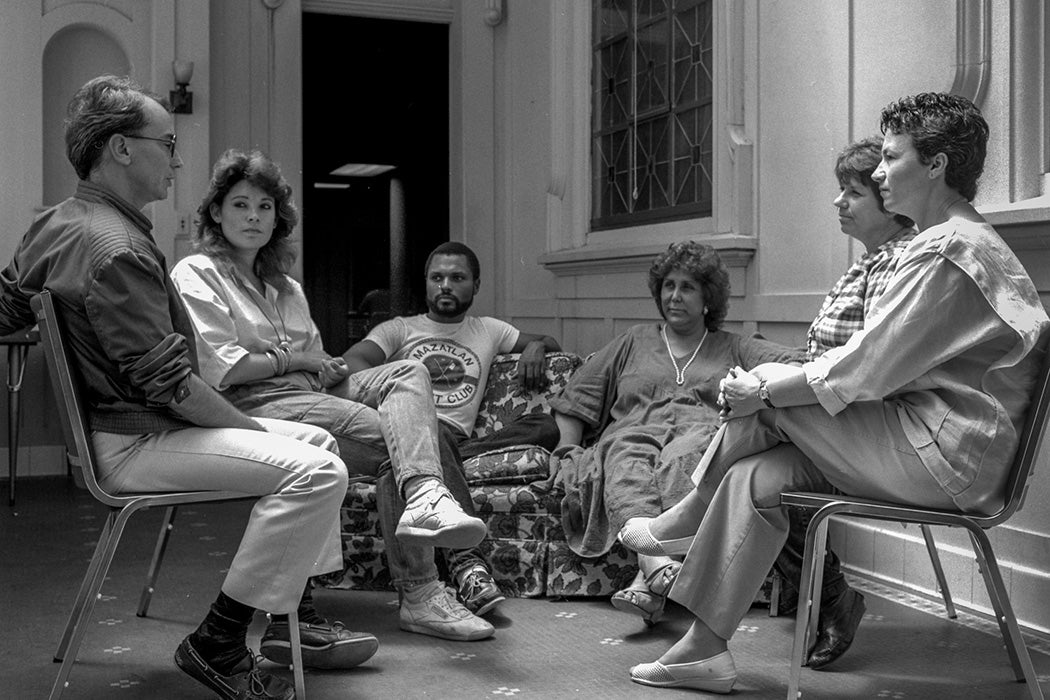
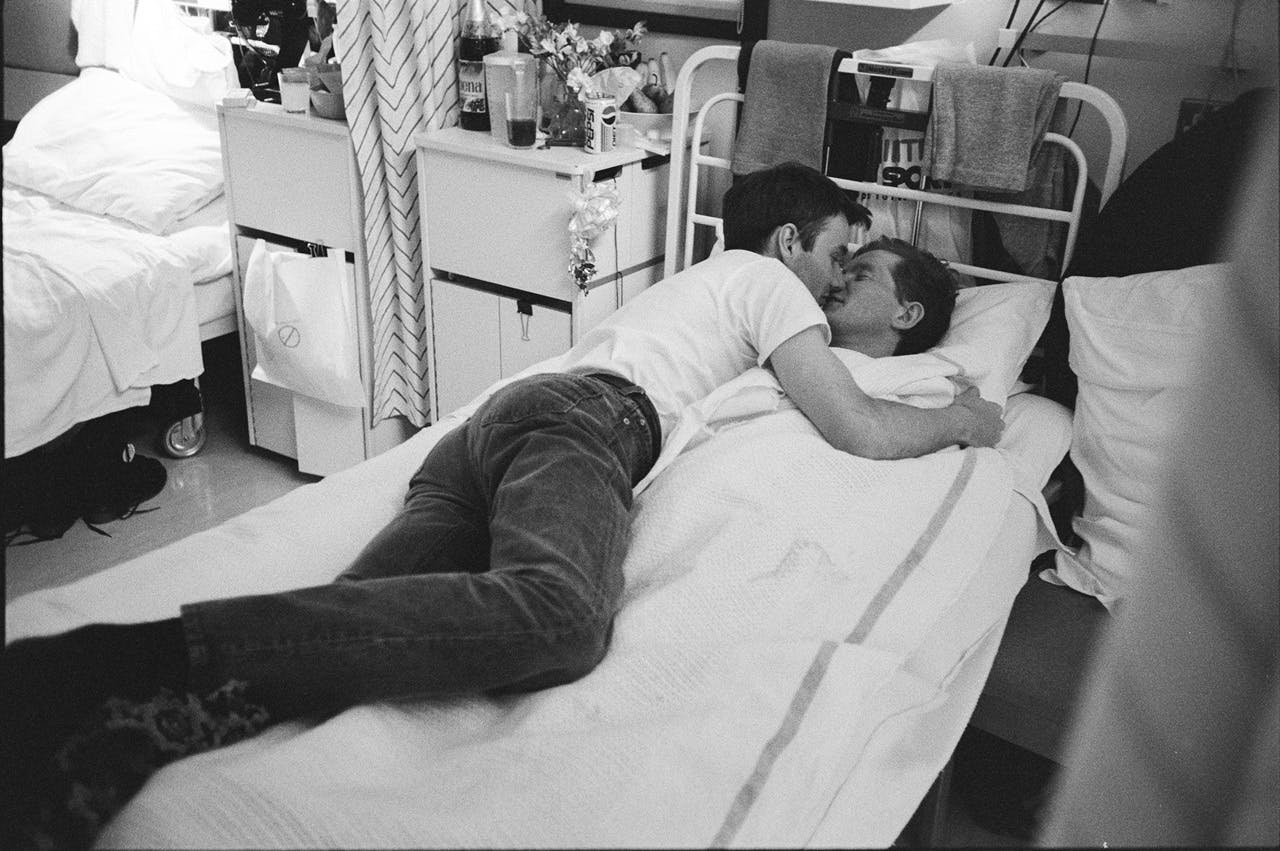
Photo: Photographer Gideon Mendel documents the AIDS crisis, choosing to focus on the intimate moments shared between gay men and their loved ones in hopes of dispelling the stigma around HIV positive individuals. On this particular image Mendel comments “There’s one particular photograph of John and his partner Michael kissing on the bed,” Mendel continues. “It’s a very touching photograph. A lot of people respond very strongly to that intimacy. Particularly in seeing that intimacy in a hospital ward.”
Bibliography:
Community care in the AIDS crisis – JSTOR DAILY. (n.d.). Retrieved April 18, 2023, from
https://daily.jstor.org/community-care-in-the-aids-crisis/
Jackson Levin, N., Kattari, S. K., Piellusch, E. K., & Watson, E. (2020, October 8). “we just take
care of each other”: Navigating ‘Chosen family’ in the context of health, illness, and the mutual provision of care amongst queer and Transgender Young Adults. International journal of environmental research and public health. Retrieved April 18, 2023, from https://www.ncbi.nlm.nih.gov/pmc/articles/PMC7579626/
The humanity of the AIDS crisis captured on film. Huck. (n.d.). Retrieved April 18, 2023, from
https://www.huckmag.com/article/gideon-mendel-the-ward-hiv-aids
 using WordPress and


Comments are closed