Written by Zaria Griffin
For many their identity of being queer is seen as a defining characteristic for them. There’s often an assumption that being queer equates to a similar experience for all and a shared struggle for rights and so on. However, this is not the case for everyone. Intersecting identities of things such as race, gender, and even social class affects how these things look for everyone. Looking at the experiences of Black women, they are a great example of this. To many the identity of race is often considered over all else when it comes to rights. But this is not always the case. In an interview conversation between Audre Lorde and James Baldwin, we can see this happening.
Throughout their conversation, you can see they disagree on some issues within the black community. This isn’t because they don’t share the same identity of being Black. But more because they have other identities as well that affect one another. Their different identities of being a man versus a woman come into play and the topic of intersectionality becomes important. With their different identities in mind, Ms.Lorde and Mr. Baldwin, seem to focus on different social issues within the shared community of being African American.
For Mr. Baldwin, this is the idea of the American Dream and how or where African Americans fit into it. While on the other hand, Audre Lorde is far from focusing on the American Dream and is focused more on her identity of being a woman. She even goes as far as to say “[ ] honey…Nobody was dreaming about me”(Baldwin and Lorde 1984). This is not an extreme stance to have considering the history of exclusion black women, and other POC women, have experienced in the United States. Although black women in many instances have been a part of a variety of movements and allies to many, they are often left out.
Organizations such as The Gay Liberation Front founded in 1969, following the Stonewall riots is an example of such. From this initial organization, many members split off because of feelings of exclusion, sexism, and racism. Thus, resulting in many previous members starting their own organizations and finding family within them. Black lesbians from the initial Gay Liberation Front separated into The Black Lesbian Caucus in 1971. Which was created out of “the need for a space where lesbians of color could gather in community and have discussions of racism” among other things (NMAAHC). Although black lesbians, like all other queer people, were facing prejudices and discrimination for being queer and women, they also faced racism.
Racism came not only from those already homophobic towards them but also from fellow members within their own organizations. Because of this Black lesbians along with Latinx Lesbians worked to found “Salsa Soul Sisters” with its name “highligt[ing] the inclusiveness of Black women and Latinas in the organization” (NMAAHC). Which later continued to include “Asian American and indigenous lesbians, gays, bisexuals, and same-gender loving women” (NMAAHC). The creation of The Black Lesbian Caucus and spaces alike worked to help support POC and Black Lesbians in the midst of negative power structures found in many queer organizations. In doing so, they also worked against heavily heterosexual and patriarchal structures. They did not allow social systems of power to continue into organizations already predominantly serving marginalized groups.
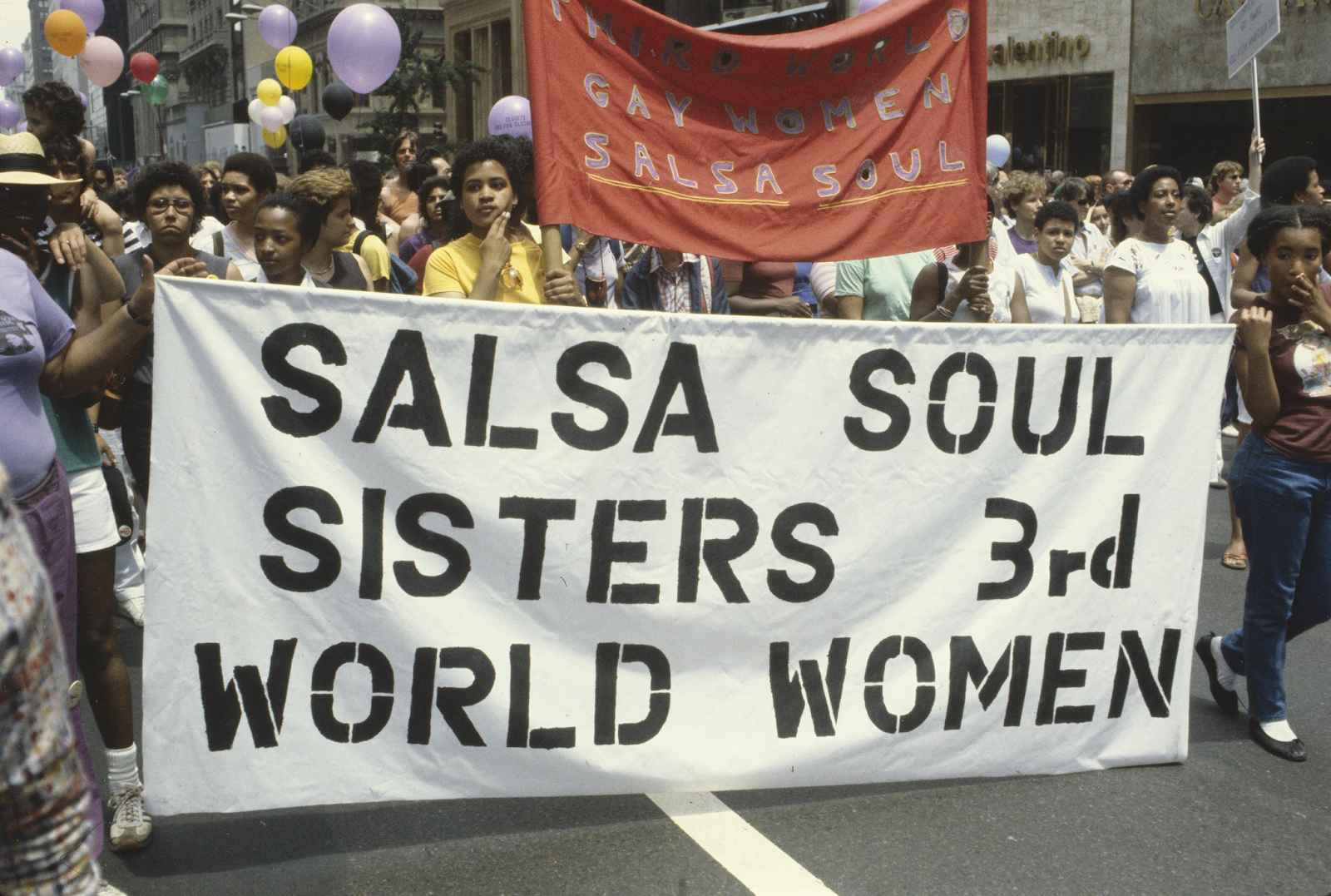
Simmons, Ron. Marchers with “Salsa Soul Sisters” Banners. 1993.
Bibliography:
Simmons, Ron. Marchers with “Salsa Soul Sisters” Banners. 1993.
Mocada-Museum, . “Revolutionary Hope: A Conversation between James Baldwin and Audre Lorde.” Tumblr, 15 Jan. 2014, https://mocada-museum.tumblr.com/post/73421979421/revolutionary-hope-a-conversation-between-james.
NMAAHC, National Museum of African American History & Culture. “Salsa Soul Sisters.” National Museum of African American History and Culture, 16 June 2022, https://nmaahc.si.edu/lgbtq/salsa-soul-sisters.
NSWP, Global Network of Sex Work Projects. “Street Transvestite Action Revolutionaries Found Star House.” Street Transvestite Action Revolutionaries Found STAR House, 2023, https://nswp.org/timeline/street-transvestite-action-revolutionaries-found-star-house
 using WordPress and


Comments are closed