Written by Zaria Griffin
Upon reading the article Families We Choose: Coming out to “Blood” Relatives, there were several important issues mentioned throughout. These issues included heteronomativity in families, fear of rejection or ostracization, the comparison of “new gay vs old gay”, and so on. In reading the article, differences in family dynamics are shown as well as the anxieties many young and older people felt from possible rejection and the problems that would follow. The article began with an emotional recollection of a young man who asked to be prayed over as he planned to come out to his family. Considering that many people would not have even considered such a thing previously this could be growth for our society.
Be that as it may, for many the idea of telling family members was not an option and grounds for societal repercussions for themselves and family. The thought of coming out to family and just in general to many people was and still is considered unheard of. This is especially true for older generations of queer people, Black and POC especially. The author mentions that for many “people perceived little to gain and everything to lose by claiming a gay identity in a heterosexual context (Weston 43-75).” I think this quote alone says a lot about the power within our society that comes from being heterosexual or just presenting as such. Many people, especially those coming from low-income or marginalized backgrounds often find support from family and friends. When there’s a loss of this support the effects are seen more than just in a social context. In the United States, family is often seen as a person’s first support system and where one can find unconditional love.
But when identities go against what is socially accepted and deemed wrong how much of yourself can you hide for the sake of family? As mentioned in the article, “coming out to a biological relative put to the test the unconditional love …commonly understood in the United States (Weston 43-75)”. Although one’s family is said to be a person’s foundation for several things, such as who they are as a person it can also be the reason they hide who they actually are. Because of these instances where biological families are not as accepting of queer identities, many people choose an alternative. Creating chosen families is a common thing among many queer people especially those who have other identities that further put them at risk.
With the ostracization from families that often follows coming out so does the loss of things such as housing security, financial support, etc. Which leaves many queer people, youth especially, out on their own. With this in mind, many queer people have come together to provide spaces that support one another and youth especially. In doing so, they help to actively work against the many power structures within families and society that work against them. A great example of this is the Street Tranvsvestite Action Revolutionaries (STAR) House founded by house mothers Sylvia Riveria and Marsha P. Johnson.
The STARS House was founded in 1970, following the Stonewall Riots in 1969. Their primary goal was to help queer youth, trans youth especially, those who were on the street find food, clothing, and a safe place to live. Though they aimed to keep the youth away from the streets, house mothers Ms. Riviera and Ms. Johnson used it as a means to pay the rent and fund educational programs.
In addition to helping queer youth, they served as a place for community connection beyond biological family units. In creating this shared space for queer youth and people in general, Ms. Johnson and Ms.Riveria set the model for future houses to come. Which did a great deal to combat the social inequalities facing them and others alike. They saw that “ the needs of street youth and transgender youth were not being accounted for by other[s]” and the STARS House was created for this purpose and to meet the needs of those left out (NSWP, 2023).
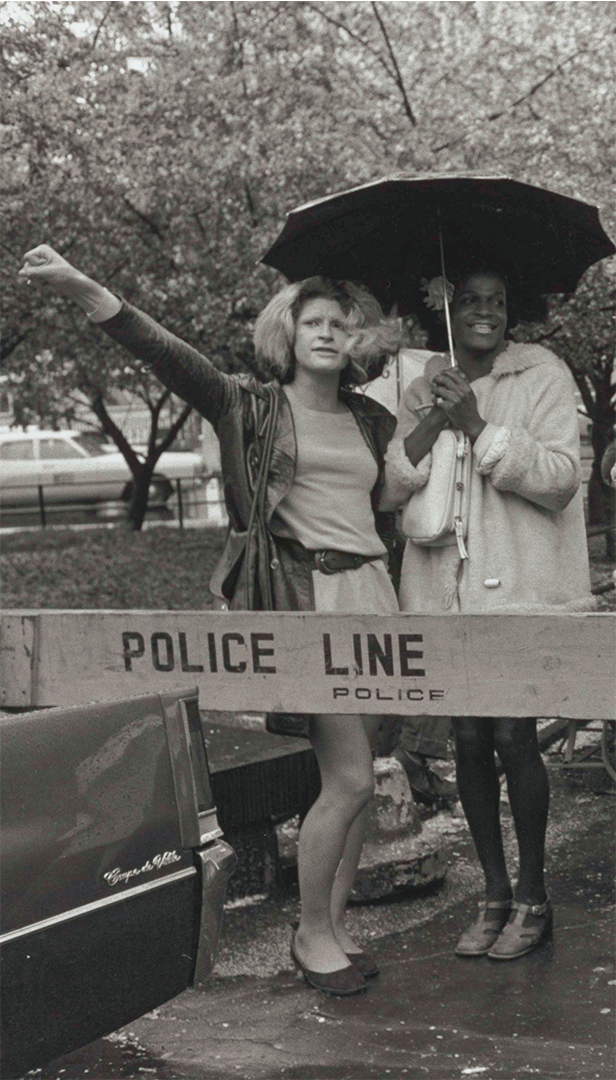
Photo : STAR House mothers Sylvia Riveria (Pictured Left) and Marsha P. Johnson (Pictured Right) shown together at the police line of a city hall rally for gay rights in 1973.
Unknown, . Transgender Rights Activists Sylvia Riveria and Marsha P. Johnson. 1973.

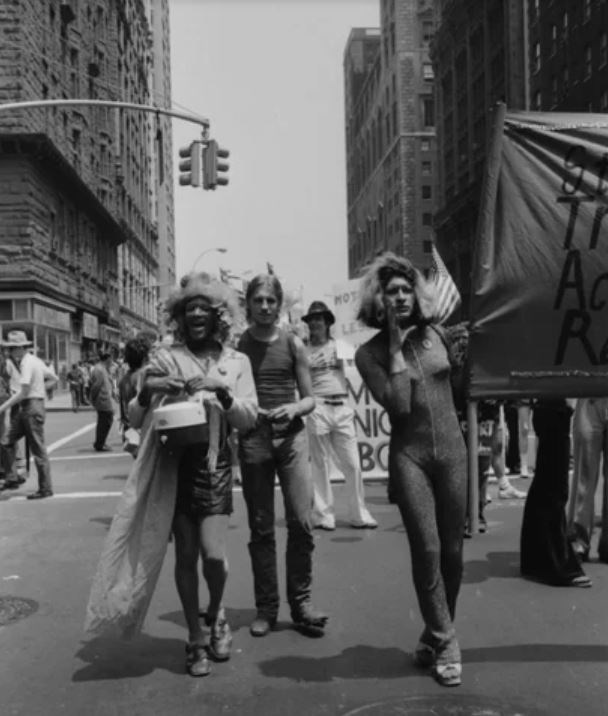
Fink, Leonard. Trans Icons Marsha P. Johnson and Sylvia Rivera at the Christopher Street Liberation Day March. 1973.
Bibliography:
Fink, Leonard. Trans Icons Marsha P. Johnson and Sylvia Rivera at the Christopher Street Liberation Day March. 1973.
Unknown, . Transgender Rights Activists Sylvia Riveria and Marsha P. Johnson. 1973.
Weston, Kath. “Coming Out To ‘Blood’ Relatives.” Families We Choose: Lesbians, Gays, Kinship, Columbia University Press, New York, New York, 1997, pp. 43–75.
 using WordPress and


Comments are closed